Tuesday, 22 February 2011

Geometry

Always I've liked geometry in all the senses: mathematical, philosophical and aesthetic. It has been my main source of inspiration together with the Golden Ratio. Even in the covers of my notebooks there is a rational analysis of composition on the basis of the covers' format with the proportion of size and position of the papers making the collages. When I draw, my drawings are abstract and geometrical using proportions. I don't understand geometry without precision, or at least, I didn't until now.

I'm starting to make some drawings on the covers of my new noteboos, minimal drawings with basic geometrical shapes on the basis of some drawings from some years ago that I've shown in flickr. These new covers with drawings will be without adding too many materials to the list of materials I already use for the collages, only pencil, black, grey and white acrylic paint (no colors) and chinese ink.

The idea of making drawings on the covers is because of the time I spent in London recently. It was very inspiring, although not productive because I couldn't make any notebooks, but I got a new point of view on the way of drawing with geometry.

Every time I went out in London was mostly for going to contemporary art exhibitions. After some time I realized that my favorite artists today are women who work with a more organic approach to geometry: Rachel Whiteread, Ellen Gallagher, Anna Helpher  and others. The work of these female artists opened my eyes and made me understand how geometry without precision and rigidness, drawing freehand lines by hand without precise measurements can be organic and as alive as a plant, finding there as much beauty as I find in the strict geometry of Richard Talbot´s drawings.

I'm starting my drawings for my new notebooks as always I've drawn, with the precision of a ruler and a calculator. But with the goal of finding my way for making my geometrical drawings more organic with freehand lines and without the precision of measurements. It will be a process of learning.

Rachel Whiteread
Anna Helpher
Richard Talbot

Sunday, 30 January 2011


 On Monday I'm leaving London to go home to Sweden. That means new crafts. I wasn't able to make notebooks in London as I was hoping, it's a really inspiring city. But I also get inspired in Linköping, the town where I live with its quietness and forests.
I want to thank all the new followers of this blog in all the time I haven't been posting anything and to the old followers that have been here even when this blog has been abandoned.

Wednesday, 21 July 2010

Transfers


Since some time ago, I'm experimenting with layers of papers making transfers of texts and also transfers images that I can show here later. 

Every notebook for me is a new field of experimentation with collages, starting from what I made in the previous notebook and finishing with something new that is for me a new discovery to apply in the next notebook. In that way, never I can repeat the same design and either exactly the same technique of collage.

The enjoynment of experimenting with papers and the beauty of their properties is something difficult to explaine. But I can show a couple of pictures of my last notebook. I'm very satisfaced with what I've got with it and it is one of my favorite notebooks I've made. I hope you like it.

Tuesday, 6 July 2010

_* R E U N I O N *_

These last posts are condensed notes of things I think while working with my crafts. I don’t pretend them to be very understandable, they are quite cumbersome; but to share them, because these are answers I’ve found to my questions about what crafts are for me.
I´m sorry for grammar mistakes.
I said in my previews post "Style" that the style of my notebooks is their essence and in my other preview post "Essence", I said that Heidegger explains that to like something is a correlation between our essence and the essence of what we like.
The style of my notebooks is the way I show the essence of a notebook.
The style of my notebooks is one between all the possible ways that a notebook could be made by others.
To like something is trough our perception of the thing.
Perception is the internal sensation as a result of a material impression in our senses. The perception presents to me a set of sensations as the way in which I'm affected by the notebooks. In the perception of my notebooks I find the correlation between my essence(mind) and the essence of the notebook.
The perceptual thing, the notebook, is in the middle between my essence and its essence (its style). They form part of the collection or constellation of properties (the notebook´s materiality), plus the characteristics of the style.
Constellation suggest a turn, movement, a directed movement that takes me in direction to a reunion between the essence of the notebook and my essence.
The reunion is the union of all of what the notebook gives me through its materiality and style plus all the sensations I get trough my perception of them.  The re-union is the correlation between my essence(mind) and the essence of the notebook in the interior of that constellation. This reunion is a reflective detention, an inward-looking, an introspection where I'm taken at the moment of writing in the notebook or when I hold it in my hands feeling its materiality. In this way is how the notebook makes me wish to write in it and inspires me trough my connection with it.

Tuesday, 29 June 2010

E s s e n c e

When we like something, to like is like an attraction that we feel for the thing we like. That attraction is because the thing has some element or something that we can recognize as part of the whole kind of things we like. But all that whole kind of diverse things have something in particular that is one essence. That essence is our style. Our style is the way we visually represent our way of being. So when we find something we like, it is like to find ourselves represented, reflected in that thing. There is a correlation between the thing and us.  Heidegger said that we only really like what is previously given from itself (from its essence), wishing us in our essence, approaching our essence and we let the thing we like to come to us (like in a feedback),and what we like is pulling us, guiding us to its essence. Heidegger uses the visual metaphor of what is "looking to us": we only see (the essence) what is already looking to us (to our essence) and we see it because it sees us.
According to Heidegger, to like is to form a relationship with our essence to the essence of what we like.

Friday, 25 June 2010

S T Y L E


Dictionary: Mode, manner, way of behavior. Practice, perform. Set of characteristics that make up the character of the work.

The characteristics are the permanent and essential aspects of the visual that give a particular character to the notebooks, for example, the use of natural materials, the look of aged books, the colors I am used to using, the kind of papers like envelopes, paper bags, wrinkled papers, torn edges, typewritten and handwritten texts, bold stitched patterns, smooth and polished surfaces and any other characteristics that I could always add. These are the characteristics of my notebooks that make them different from others, because of the way I apply these characteristics. The set of characteristics plus the properties of natural materials (materiality, qualities, exterior surface or apparency) make a unity, a whole. That unity with its characteristics and properties is the style, the character of my crafts. The unity of the style can express itself in a multiplicity of possible interrelations between the properties of materials and the way of working. That unity is the same in every part and every one of my notebooks, this way every notebook I make can be different from each other inside the same style. The unity of the style is its essence and it behaves as a collection, a constellation made of properties and characteristics.  The style is the order, the way of showing that constellation. The style is that constellation. The constellation is the essence. The style is the essence.

Thursday, 10 June 2010

Properties As My References.


I’m starting this post as series of short posts based on small notes I take while working with my crafts. So this post is to be continued.

4454379198_2cfd34919f When I'm making my crafts, I always have some references in mind that influence and give me ideas. These references are mostly objects I see. Also, when someone ask 'What inspires you?', has the preconception of that you are inspired by some kind of figurative thing, because if you are making something like a simple notebook, you may be inspired by some object or figurative image, and that is true many times, but not always. In my case, the objects or figurative images that inspire me are, for instance, aged books with broken covers and yellowish pages that I often find in antique stores. Then, when I think, for example, about these books at the moment of trying to get new ideas for making the next notebook, I'm remembering these books and the way I saw them. This means that I'm using my visual memory and that the inspiration for my work is quite based on my visual perception. I have a big inventory of images in my memory where I take new ideas from. Visually and figuratively.

But there is something else apart or together with the visual perception of the inspiring objects and their images in my memory. It is something inherent in the objects or more precisely, inherent in the material of the objects. It is the natural properties of the materials, their essential qualities, and that is where I find their beauty and inspiration.
I find these natural properties only in natural materials, of course, like the kind of papers I use for my notebooks, wood, leather, linen… It means that I'm not only inspired by old broken books.
 
There is a strong attraction I feel for these qualities, they inspire me and that is what gives me pleasure in working with crafts.
The pleasure or sensations of the properties is something that I'm always trying to analyze while working with some notebook or other crafts. More precisely, what I try to analyze is the relationship between my internal sensations with the perception of the natural properties of the materials that are external to me. It was because of that relationship that I started making notebooks. I wanted a notebook that was in complete relation between its properties and qualities and my mind.

Saturday, 24 April 2010

Some News

I haven't been updating this blog or my Facebook Page for many days. I've had a time of introspection and quite a lot of inspiration playing with new kind of (recycled) papers that I haven't used before, searching for new techniques and textures.These new notebooks are made with collages that I was experimenting with. Introspection and inspiration never end, but it is time for me to show and write you something.
These are two of the notebooks I'm making and uploading to Flickr

Auxian (Large) Auxian ii (Large)
“"Axian" with a new kind of binding.

Quain (1) (Large) DSC_0102
“Quain” A little experiment with the format.

Monday, 1 March 2010

A Meaningful Logo For My Crafts.


Logo
Some time ago I thought that my crafts need a logo. After making some designs I realized that it had to be meaningful. Not a meaning given to me, but for the native people of the place that I feel closely related to, that is Patagonia in Argentina. The native people from Patagonia are called the Mapuches. They have a millenary symbol that is a musical instrument called Kultrum and they are also using it today in their flag.
 For an easy explanation of the symbol and its meaning I have made a translation from a short description in Spanish in Wikipedia.

“It is a bowl-shaped drum, approximately 35 to 40 cm diameter and with a height of 12 to 15 cm.

It is the most important musical instrument of the Mapuche culture, it is used by the machi (medical, healer, shaman) for rituals as well as during the rogation of Nguillatun (annual rite of fertility).

The kultrum or Cultrun with its bowl-shaped form represents half of the universe or the world in the Mapuche world view, in the leather patch of the drum the four cardinal points are represented, which are the omnipotent powers of Nguenechen (God) master of the universe. These are represented as two-way cross lines and their ends branch into three lines, representing the legs of choique (ostrich); inside the rooms that are divided by lines described above the four seasons are drawn”.

For the logo of my crafts I have extracted the drawing in yellow circle with the brown cross on the leather patch of the instrument.
Kultrum
Reblog this post [with Zemanta]

Sunday, 28 February 2010

Good Feedback.

It is always a pleasure to receive nice comments for my crafts. It means a lot to me and makes me feel inspired to continue improving my work and experimenting with new ideas.

Here is a comment I received today from ArtcyLucy who bought the 3&4 notebook (the notebook in the picture of the previous post).

"Sebastian, I received my beautiful notebook this week, and I LOVE it! The cover is exquisite...the collage is unique, with a beautiful old-world worn feel to it. Thank you so much...I look forward to filling the book with my own art".

Many thanks! 

Wednesday, 20 January 2010

Mixed-media Series.


3&4
Originally uploaded by B a s t i a n o

When my sewing machine broke down a couple of month ago and I couldn't continue making the stitched patterns that had become a classic on my notebooks, I thought that stitched patterns were essential for the style of my notebooks. It was like an identity crisis for a moment.

However, I think that necessity is the mother of invention and invention is creativity. Since my machine broke down, I've started a new series of notebooks with collages on the covers.

As always I'm using recycled papers and almost never without modifying them first. There is always something to change. It is a process that takes many days and involves coffee, tea, eggs, typewritten texts, acrylic paint and polish. I scrutinize each paper for every detail of their natural properties and qualities in order tor make the beauty of torn edges, wrinkles, stains and their smooth tactile qualities visible. All papers are in brown, ochre colors and tones of grey.
Nothing selected
Reblog this post [with Zemanta]

Tuesday, 22 September 2009

C r a f t i v i s m

There is a very interesting topic for me called Craftivism. Maybe you know it. I discovered it last year and it has become for me an important topic in relation with something else, that is the Open Source philosophy, the topic I've slowly started researching on my own. All this is in relation with Ecology, Recycling and so on - topics that I've always seen in relation with my notebooks and my activities as a crafter. These are some of the things that inspire me in my work with my tools and materials and with my laptop and the new media on the Internet like Firefox, Linux, etc.
 
One good way to explain what is Craftivism for me is to post some extracts from the definition from Wikipedia:
 
"Craftivism is a form of activism, typically incorporating elements of anti-capitalism, environmentalism or third-wave feminism, that is centered around practices of craft - most notably knitting. Practitioners are known as craftivists".
 
But for me, is more interesting the part related to Environmentalism:
 
"Craftivism is also centered around ideas of environmentalism and sustainability. When buying new materials, many craftivists choose organic fabrics and fairly-traded products such as home-spun yarns. Yet, even more popular within the movement is the utilization of vintage, thrifted and repurposed goods in order to minimize waste and promote reuse. This display of resourcefulness acknowledges the finite resources on Earth, and the valorization of quality over quantity. Craftivist, Betsy Greer, is quoted saying, “While I think that crafting has become something fairly elite and cliquish in some areas, at its heart, it is very much made for individuals who value both their time and their money”
 
And the other part of my interest, related to the Open Source and the DIY movement:
 
"A popular way to resist the commoditization of craft is through the Do-It-Yourself or DIY movement. Popularized through "zines" of the 1990’s, DIY inspires people to be self-sufficient and to rely less on the market for basic necessities that can easily be created on one’s own. DIY is a resistance to the both the capitalist nature of the fashion industry and pressures to conform and buy a style. An example of this is the Counterfeit Crochet Project, which seeks to "debase and defile designer items one step at a time". Crafters have also subverted the market through the use of open source patterns and information sharing on the internet. Sites like Burdastyle allow crafters to upload and download sewing projects at no charge. Similarly, Cat Mazza's online software KnitPro allows users to download images into detailed knitting patterns at no charge"
 
My research with these topics is starting and I will post more notes about it when I have something else to share. I'm doing this in a very informal way without any academic method and with my English that is not very good.
 
If someone feels like making  a comment, I will be very thankful.
Reblog this post [with Zemanta]

Tuesday, 8 September 2009

A raven flying to Taiwan.


I’m going to update this map that has been abandoned for quite a long time.

This is not a new pin on the map, but a new notebook in the pin for Taiwan. This is for Must Ronk (Black Raven), the black notebook I made inspired by the crows from Estonia. This notebook has been flying with me back and forth between Sweden and Estonia during its making this summer, and ended up flying alone to Taiwan.

When I thought about a completely black notebook, my question was that you cannot write or draw on it with a regular pencil and it should be white to be visible - that can be visually interesting - but in the end it didn´t matter. For the first time I’ve made a notebook just thinking about its aesthetics and not to much in its function.

Finally Must Ronk found its rightful owner in Taiwan the same day I put the pictures online in Flickr. She is an artist who has bought also another one of my notebooks, Nervation. It is very nice for me to think that some of my notebooks are so far away from me, appreciated by artists and used for their work.

Reblog this post [with Zemanta]

Sunday, 6 September 2009

Alo ja Leila Lugu or Alo & Leila's Story.

This book captures the love story of Alo and Leila who are getting married today in a small peninsula in Estonia.
My friends are interested in eco-friendly life and folk traditions. With this scrapbook I've tried to mix a bit of the style of Estonian folk traditions, especially in the choice of materials like linen, traditional patterns from folk clothes and linen-felt.
In the pages inside there are all kinds of hand-written papers, cards, concert-tickets, printed sms-messages and a calendar made by themselves. All things from activities they have been sharing since they met.
For making this scrapbook, I didn't want to add glue or to do any modifications to their papers, so with an idea of a botanical book in mind, I've attached every single card and tickets with thin tapes of paper from a recycled paper bag in the way that they can take off any of these cards and notes at any time. Also, there is plenty of space for adding new memories.

Hard covers, 30x21cm.


Reblog this post [with Zemanta]

Sunday, 9 August 2009

F U S I O N

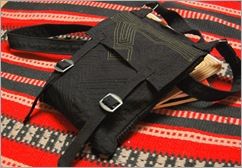
After a long while not updating this blog I want to show some kind of experiment. I'm trying to make messenger bags with a similar style to the notebooks, but based on an idea that I would like to develop together with the style of the bags.
I attempted to make a small bag looking as simple as possible, but with a lot of work with the stitching pattern, like with the covers of my notebooks. Fusion is the name of the bag because it is the name of the idea that I want to work with. This idea is about my re-encounter with the most essential and primitive geometrical patterns of cultures from South-America, that is my origin and discovery of the similarities they share with primitive geometrical patterns from Northern Europe, that is the environment where I live now. To do so, my designs won't try to imitate patterns from South America or Northern Europe, but they will have a touch of the essence I find in common between them from my personal point of view. 

2 (Medium)
1 (Medium)


Reblog this post [with Zemanta]

Sunday, 10 May 2009

M O T H E R ' S D A Y


The new pin on the story-map is located in Spain, where the Mother's Day was last sunday(May 1st) and  my notebook Yoko is  there, because my mother lives in Alicante, Spain. Yoko was my Mother's Day present for her. She is going back to Argentina in June, the next month I will have to move the pin to the other side of the map.

For shipping my notebooks I put a wrapper around them with a typewritten text that I take randomly from books of art , philosophy or Google. The text I used for this notebook is from Yoko Ono:

"Touch Poem V" 

                 Fill the wall.

                       Examine its temperature and moisture. Take notes about many different walls.

                                                                                                                   1963,  autumn. YOKO ONO

Monday, 4 May 2009

Nervation, Crappy and Venation

NERVATION CrappyVenation

Nervation, Crappy and Venation have gone to Taiwan. One pin more on my story-map, but with three notebooks. The person who bought them is an artist who uses to work with her sketches and printings on notebooks "Moleskine". But now, she also likes notebooks "bastiano"

"Crappy" is her new sketchbook and "Nervation" was a custom request on base of my first Nervation notebook (15x10cm), but in big size (21x15cm). She has her shop
linguine on Etsy too and you can see her art-works on notebooks there. Who knows, maybe soon you can buy some of her art-works made on some of my notebooks.


Reblog this post [with Zemanta]

Monday, 27 April 2009

Smithson


Smithson
Originally uploaded by B a s t i a n o
Robert Smithson was a conceptual artist between the years of 1964-1973. My notebook has a double relation with him. I've called this notebook "Smithson" because of him and the second relation is with my story-map, because some of the materials that Robert Smithson used to work with, were photography, language and maps.

This notebook was a custom request from a friend from London as a present for another friend of her. She told me that her friend was working with art. At that time I had a book about Robert Smithson and I decided to use some texts of him for typewriting on the covers. "Smithson" is one of the notebooks I have put more work on it, typewriting, stitching, choosing texts,binding, etc, When making it, I got the idea of putting the elastic band in diagonal,holding the covers by the corners like in a cardboard folder.

"Smithson" has gone too and his pin is located in London in my story-map. But the owner of the notebook is now in Sweden and probably she brought "Smithson" with her. I would like to see it.


Reblog this post [with Zemanta]

Thursday, 23 April 2009

Inside out.


Nervation
Originally uploaded by B a s t i a n o
I started the story-map "Where the notebooks have gone" without a map in the previous post. I had found the perfect map I need for the story, in outside.in , but this only works in the U.S. Finally I found one that comply with the function I need. You can interact with the map finding many playful options.

Today I add another notebook on the map: "Nervation". It was made putting its covers inside out. When the covers were finished and ready to place on the pages with the black part inside, I realized of the beauty of the stitched pattern under the black mate paper, producing a relief that looks like nerves or veins under the skin.

Nervation was sold and has gone to Quebec, Canada. I'm glad that this notebook was bought by a sensitive person who knew to appreciate very well everything I put working on the notebook.

Now I am making a custom request in the same style of Nervation that will go to Taiwan. But this is a story for another pin on the map in the next post.

Tuesday, 21 April 2009

WHERE THE NOTEBOOKS HAVE GONE.


Cherry
Originally uploaded
Every one with an online shop sells products to different countries. This is nothing out of the ordinary; but I thought that it can be something nice to make posts telling you where my notebooks have gone. For that, every mentioned place in the posts will be marked with pins on a story-map that I will put in the sidebar, so you will be able to see the location of every sold notebook.
This post has also function of "story-map test" to see how this map works. I can try this idea starting with "Cherry", the first notebook posted in my blog, but not the first one I made.
"Cherry" is in Tartu, Estonia. This notebook was not sold, but was made as a present for Riina, my girlfriend's mother. She gave me an old roll of paper of Telex -an old communication system today useless- and I gave her this notebook as gratitude. Many times she gives me materials for my notebooks.
"Cherry" has 80 hand sewn blank pages of old telex paper . The covers are made with red envelopes that have got a beautiful cherry color after the treatment I give always to the covers papers, not properly visible in the pictures and it is one of my favorite notebooks. The size is 15x10.5cm


Reblog this post [with Zemanta]
Related Posts with Thumbnails